

Lemon Creme Brulee
This Lemon Creme Brulee is tested to give you a silky, never-curdled custard and that signature crackly sugar top every time. Learn exactly when it’s done, how to avoid common mistakes, and how to make it ahead for stress-free entertaining.
Save This Recipe!
“Always outstanding! I make every Christmas eve.”
—Courtney
Foolproof Lemon Creme Brulee With A Silky Custard And Perfect Crack Top
This lemon crème brûlée recipe is made with heavy cream, egg yolks, sugar, fresh lemon juice, and lemon zest, then baked gently in a water bath until just set and finished with a caramelized sugar top. The result is a smooth, creamy custard with bright citrus flavor and that signature crisp shell.
It’s a make-ahead dessert that’s ideal for dinner parties, holidays, or anytime you want something that feels fancy but is actually very doable at home.
The key to this recipe is controlled heat and proper doneness, so you get a custard that is silky, not scrambled, every single time.
Why You’ll Love This Lemon Creme Brulee Recipe
- Designed to prevent curdling, with clear visual doneness cues so you don’t have to guess.
- Uses both lemon zest and juice for balanced citrus flavor, not just one-note sourness.
- A true make-ahead dessert, so you can prep it days in advance and torch right before serving.
Lemon Brulee Ingredients And Equipment
A full recipe card, including exact ingredient amounts, appears at the bottom of this post. This section includes affiliate links.
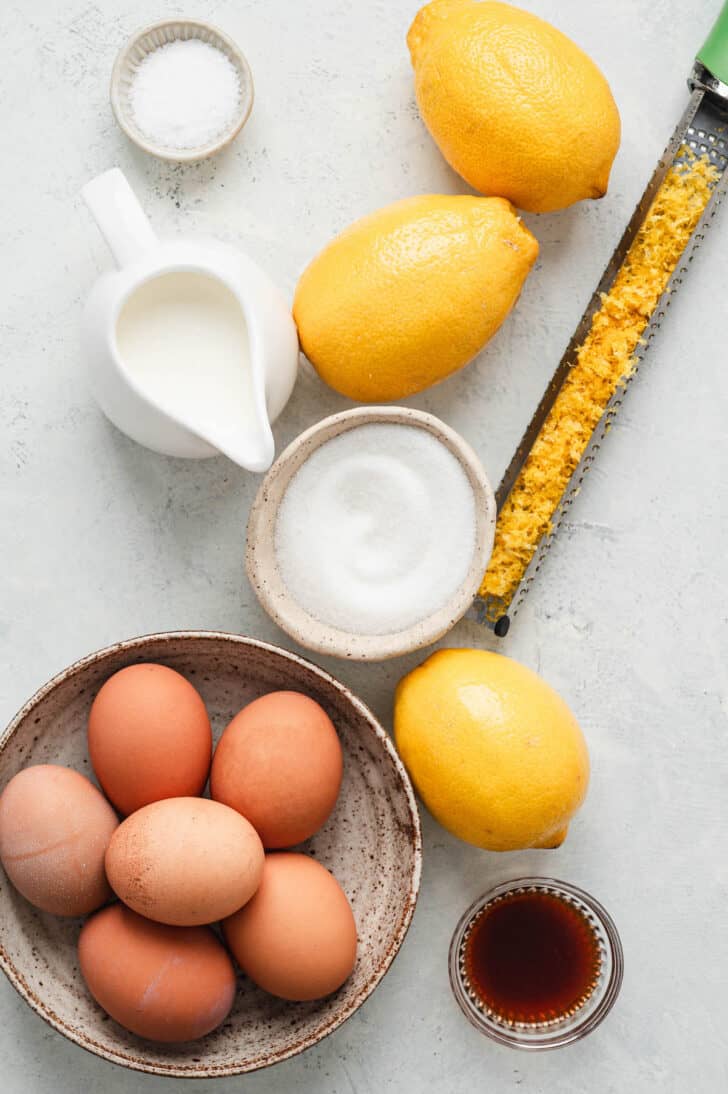
- heavy cream – this forms the rich, silky base of the custard. We use heavy whipping cream for this recipe, and that’s it. Some people use a combination of cream and milk, but after testing a lot of different dairy combinations, we decided we liked the extra rich texture of heavy cream only.
- granulated sugar – sweetens the custard and forms the crackly topping.
- egg yolks – thicken the custard and give it that classic silky texture.
- lemon zest and juice – zest adds aroma, juice adds brightness without overpowering.
- vanilla extract – just a touch for warmth and depth. Vanilla bean paste is overpowering here, so we recommend just extract.
- kosher salt – just a pinch. The finished dessert won’t taste salty, but it will taste balanced.
- blowtorch – you can use a specially made kitchen blowtorch, or just one from the hardware store. We use the full size hardware store kind.
- ramekins or creme brulee dishes – you’ll need six 5 to 6 ounce oven-safe ramekins. We used a porcelain set like the one in these photos that comes with a rack and lids, which makes it easy to transfer all the custards in and out of the water bath at once. That said, any ramekins you have on hand will work just fine with a standard roasting pan.
A Note About Ramekin Size
Ramekin size and shape directly affect how long lemon creme brulee takes to bake. For this recipe, use six 5- to 6-ounce oven-safe ramekins.
If your ramekins are wide and shallow, the custard will usually bake faster because the filling is spread over more surface area. Start checking for doneness around 30 minutes.
If your ramekins are narrow and deep, the custard will usually need more time because the filling sits deeper in the dish. Start checking around 45 minutes.
No matter which style you use, the lemon creme brulee is done when the edges are set but the centers still have a slight jiggle.
How To Make Creme Brulee Lemon
- PREP + HEAT THE CREAM. Preheat your oven and bring a kettle of water to a boil. Place ramekins in a roasting pan. In a small saucepan, heat the cream and some of the sugar over medium heat. Warm until steaming, not boiling. Boiling can cause grainy texture later.
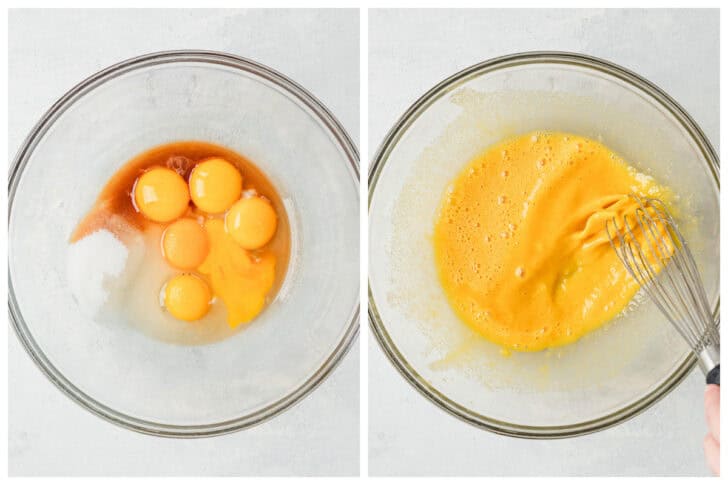
- WHISK THE YOLKS. In a separate bowl, whisk together the egg yolks, lemon juice, vanilla, salt, and the remaining sugar until smooth.
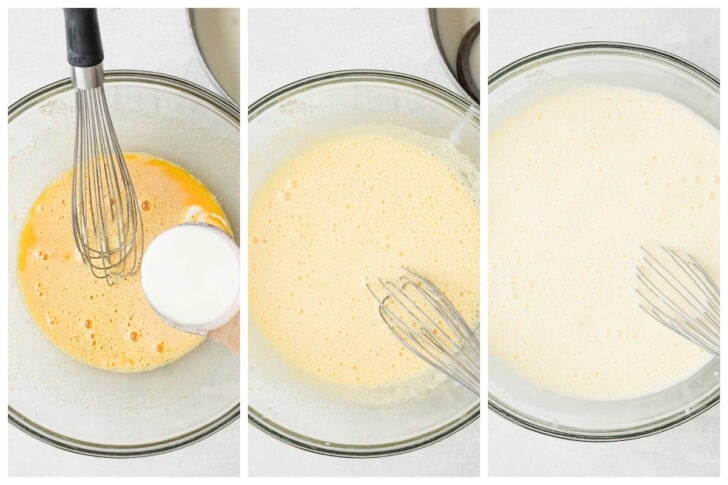
- TEMPER. Slowly whisk a few ladlefuls of the hot cream into the egg mixture. Then gradually whisk in the rest to prevent scrambling.
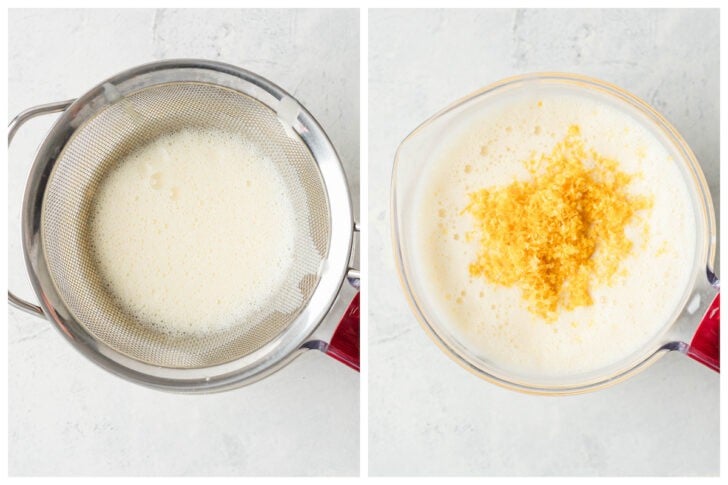
- STRAIN + ADD ZEST. Strain the lemon custard mixture through a fine mesh sieve into a large measuring cup, then stir in the lemon zest.
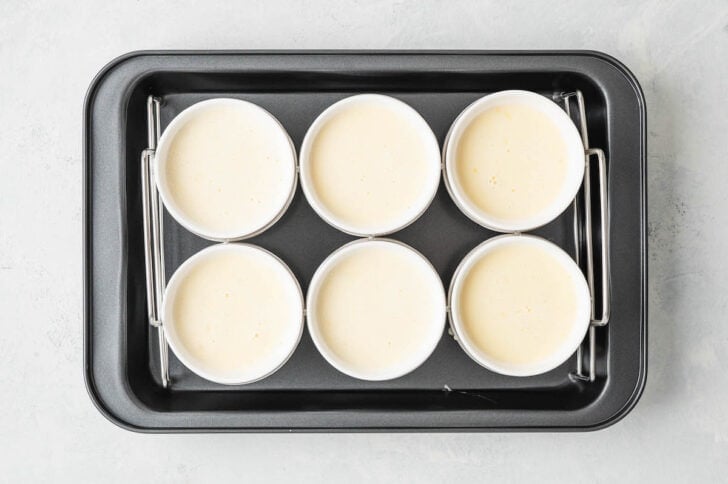
- DIVIDE. Divide the mixture among your ramekins. Carefully pour the hot water into the roasting pan until it reaches halfway up the sides of the ramekins. This water bath keeps the heat gentle and even so the custard sets smoothly.
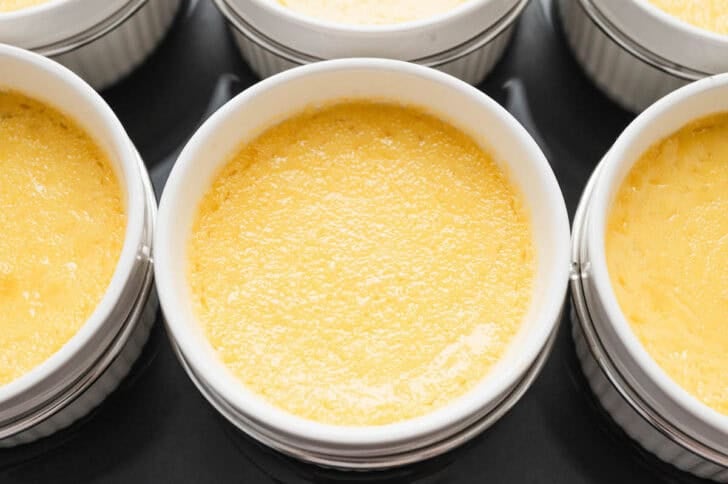
- BAKE. Bake until the custards are just set – the center should wobble slightly when shaken.
- CHILL. Use tongs to move the ramekins to a wire rack. Let them sit at room temperature for 30 minutes, then cover and refrigerate until completely chilled.
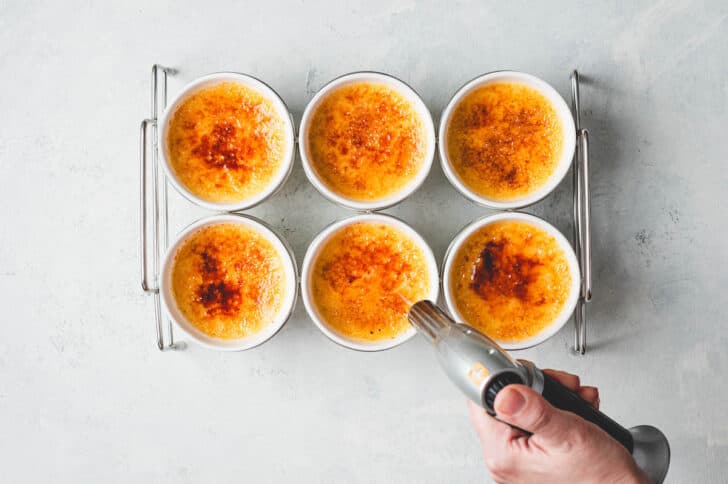
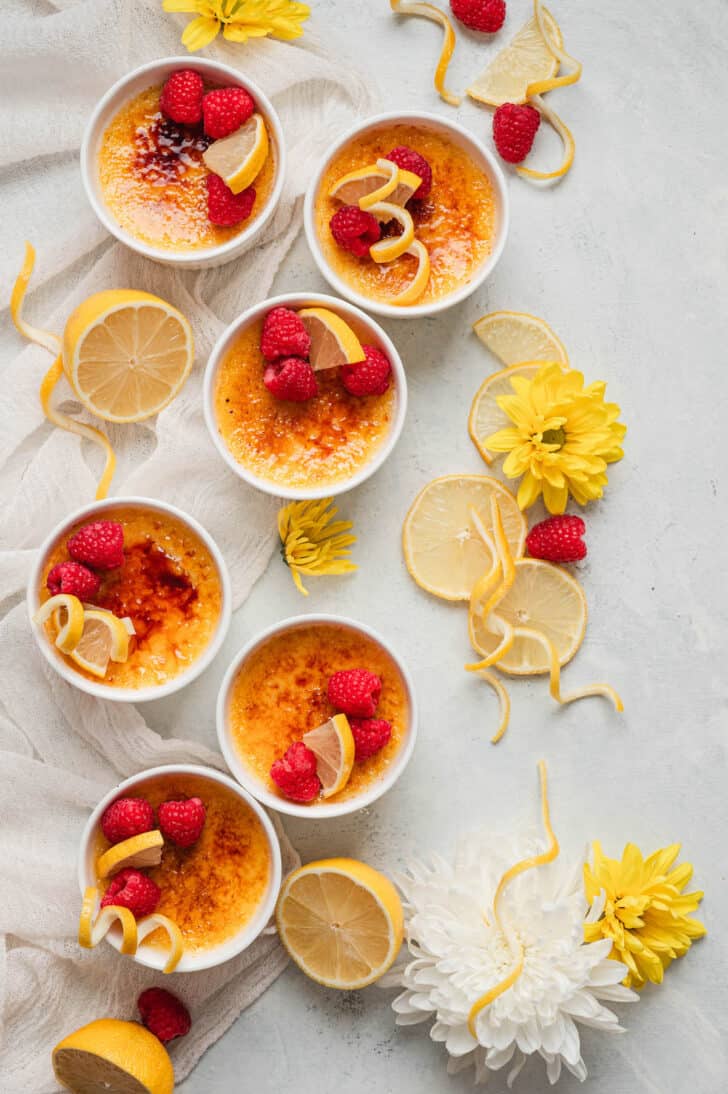
- BRULEE. Right before serving, sprinkle a tablespoon of sugar over each custard. Use a kitchen torch to caramelize the tops until golden and bubbly (or pop them under a broiler if you don’t have a torch). Garnish with berries and strips of lemon peel if you’d like to make it extra special.
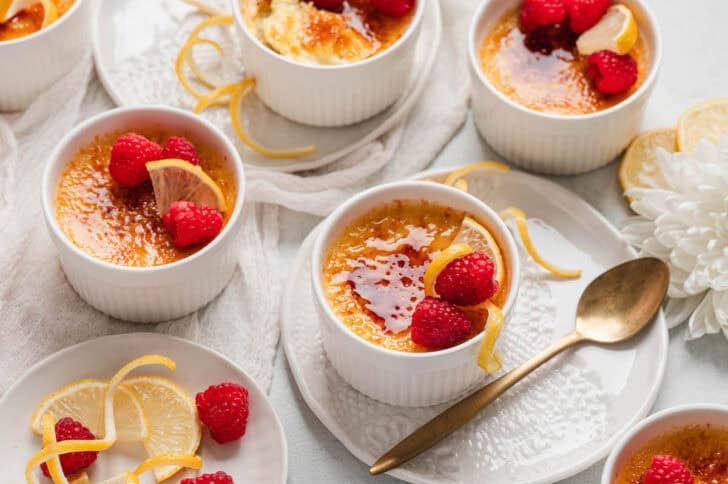
How to Tell When Lemon Crème Brûlée Is Done
The edges should be set, but the center should jiggle slightly when you gently shake the ramekin.
- If it moves like liquid, it needs more time.
- If it doesn’t move at all, it’s overbaked.
Lemon Brulee Recipe Home Chef Tips
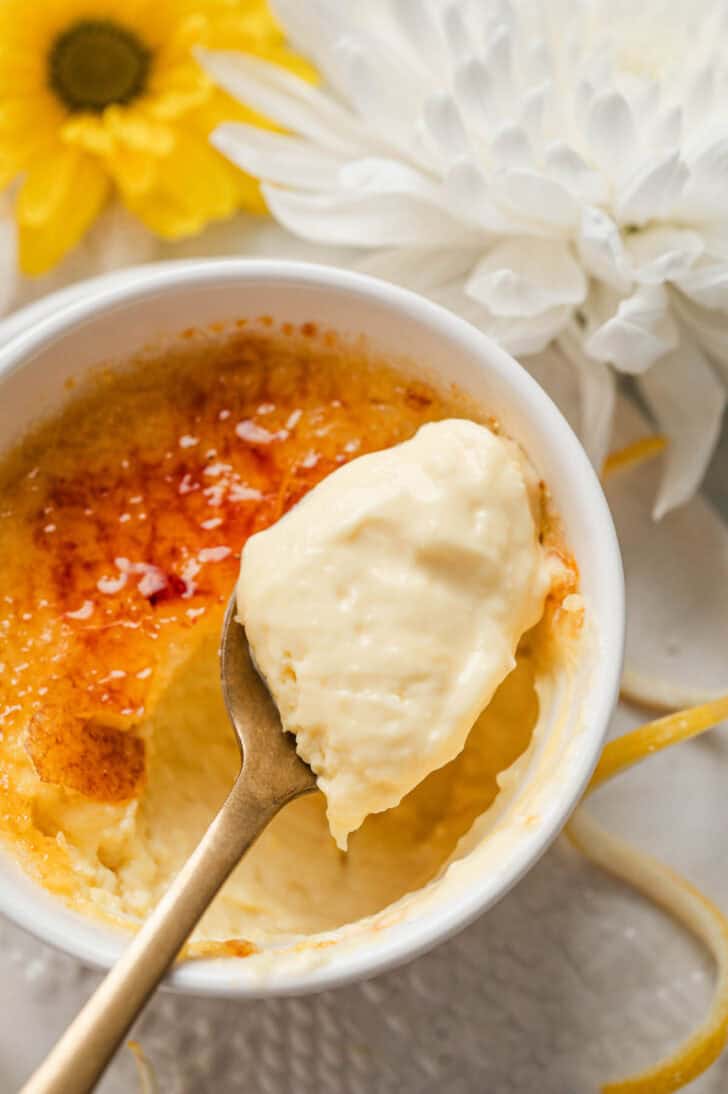
- You want to get an EVEN layer of sugar across the surface of each custard. We sprinkle the tablespoon of sugar across the custard, and then we kind of tilt and shake and shimmy the ramekin until it’s even more evened out.
- When torching, it’s important to remember to keep the torch moving constantly so none of the areas burn.
- We find it easiest to brown the sugar in stages. First, we torch the entire surface of the sugar until it is light golden brown. Then, we go back and keep torching until everything is medium golden brown. And then again until it’s all dark golden brown.
- As soon as you start to smell any sugar burning, stop torching immediately. Dark brown sugar is delicious, but burnt sugar is just bitter.
Make Ahead And Storage
- Refrigerate: Cover and refrigerate the baked custards (before torching) for up to 2 days.
- Freeze: Freeze baked custards (before torching) for up to 3 months. Wrap tightly in plastic wrap, then place in a freezer bag to prevent freezer burn. Thaw overnight in the refrigerator, then add sugar and brûlée just before serving.
More Foxes Love Lemons Favorites

Lemon Creme Brulee Recipe
Save This Recipe!
Ingredients
For the Custard:
- 3 cups heavy cream
- 8 tablespoons granulated sugar divided
- 6 large egg yolks
- 2 tablespoons fresh lemon juice (be sure to zest the lemons first)
- ½ teaspoon vanilla extract
- Pinch kosher salt
- Zest of 2 lemons (about 4 teaspoons)
For the Topping:
- 6 tablespoons granulated sugar
- Fresh berries and lemon peel for garnish (optional)
Instructions
- Preheat oven to 300 degrees F; heat large kettle of water to boiling. Place six 5- to 6-ounce ramekins (see Notes below) in roasting pan.
- In small saucepan, heat cream and 4 tablespoons sugar over medium heat 6 to 7 minutes or until cream just starts to bubble around edges of pan (do not bring to a full boil).
- Meanwhile, in large bowl, whisk egg yolks, lemon juice, vanilla, salt and remaining 4 tablespoons sugar until well combined. While whisking, use ladle to slowly add 3 ladlefuls of hot cream mixture to egg mixture. Gradually whisk remaining cream mixture into egg mixture. Strain mixture through fine mesh strainer into large liquid measuring cup. Stir in lemon zest.
- Divide mixture between ramekins; place roasting pan in oven. Add enough boiling water to come halfway up sides of the ramekins. Bake 35 to 50 minutes or until custards are just set. Exact baking time will depend on the size and shape of your ramekins (see Notes). Creme brulee is done when the edges are set but the center still gently jiggles like gelatin. If it sloshes, it needs more time. If it’s fully firm, it’s overbaked.
- Use pancake turner to carefully transfer ramekins to cooling rack; let stand 30 minutes. Then, cover with plastic wrap and chill at least 4 hours or up to 2 days before serving.
- To serve, sprinkle 1 tablespoon sugar over each custard. Using blowtorch, caramelize top of each custard until sugar bubbles and turns brown (this can also be done under a broiler). Garnish with berries and lemon peel, if desired, and serve immediately.

Always outstanding! I make every Christmas eve.
I’m so glad to hear that, Courtney!
Wow I’m going to make this today
I hope it turned out great, Evelyn!
I’m also someone who favors savory over sweet ~ for example, I can easily pass up chocolate but will rush to the head of the line for cheese! I have a very simple recipe for creme brulee that I’ve made a number of times (just combine ingredients, pour into ramekins, and cook in a water bath, cool, then top with sugar and fire away!). Husband and I both love, love, love dishes featuring lemon, and your lemon creme brulee is bound to be a hit…….can’t wait to make it!! Thanks for sharing!
Haha yes! Give me a cheese board over dessert, almost any day. Except…when it’s a good lemon dessert. I hope this recipe is a hit for you and your husband, Sue. Thanks so much for stopping by!
I love blackberries, I love lemons. I just LOVE your crème brûlée! I couldn’t help it, I had to tweet it 🙂 Congrats on the good job!
Thanks so much for sharing, Del!
Hi, just wanted to ask where you found your double handled bowls?
Pier 1!
Dying! This is my favorite dessert and I’ve been thinking about it all day since seeing your FB post earlier. YUM!
Wow, even LEMON creme brulee? You’re a woman after my own heart 🙂
YES, YES and more YES!!! Love this twist on a classic!!
Thanks so much Sophia!
I’ve never made creme brulee nor have I ever had a lemon flavoured one. Both of these things must change. I love dessert so much that I often force myself to eat it, to the point of being in intense pain in the stomach region, because I can never say no. Fact. This looks gorgeous, Lori! The custard is so smooth ‘n satiny, and you’ve got a perfect crunchy topping of burnt sugar.
Oh Nancy, you MUST make creme brulee at least once. With your pastry skills, you’ll have no trouble at all. Plus, you know…you get to use a blowtorch. Which is definitely a big part of the allure in my book.
YUM – this dessert looks fantastic Lori! You know me too and how I love lemons. I haven’t even had dinner yet and want to skip it have this instead! I’ll have to give this one a try. Pinned!
Thanks so much, Deb. I hope you get a chance to try it!
Ooh.. I am so craving this right now! I have never even made a regular creme brulee. A new addition to my ever growing to-do list
Oh, definitely add it to your list, Cathleen. Honestly, it’s not hard to make at all!
I remember the conversation with the waiter well . . .
Me: “We usually have the beer and pretzels. But, I think we are both feeling stuffed. Probably just an espresso or a cognac.”
Waiter: “Before you do that, let me run down the dessert specials.”
You: “If you must.”
Waiter: “Tonight we have homemade sorbet trio of season fruit, lemon creme brulee . . .”
You: “Let me stop you there. Is the creme brulee awesome?”
Waiter: “It’s pretty awesome.”
Me: “Sold. We’ll split a creme brulee. And, we’ll each take an espresso.”
Is this restaurant pager friendly?
I’m not getting a sig on my beeper . . .
Lmao I can totally hear you saying all of these things, especially “let me stop you there. Is the creme brulee awesome?” You’re freaking awesome for asking the question, girl.
I’m also a savory person, but this looks like a great spring dessert; bright and lively!
Thanks so much, Mary!