

Lasagna With Cottage Cheese
This Lasagna Recipe With Cottage Cheese has been an affordable, freezer-friendly favorite of Midwestern families for generations. Layers of rich meat sauce, tender pasta, creamy filling and melted cheese make it a true comfort food classic.
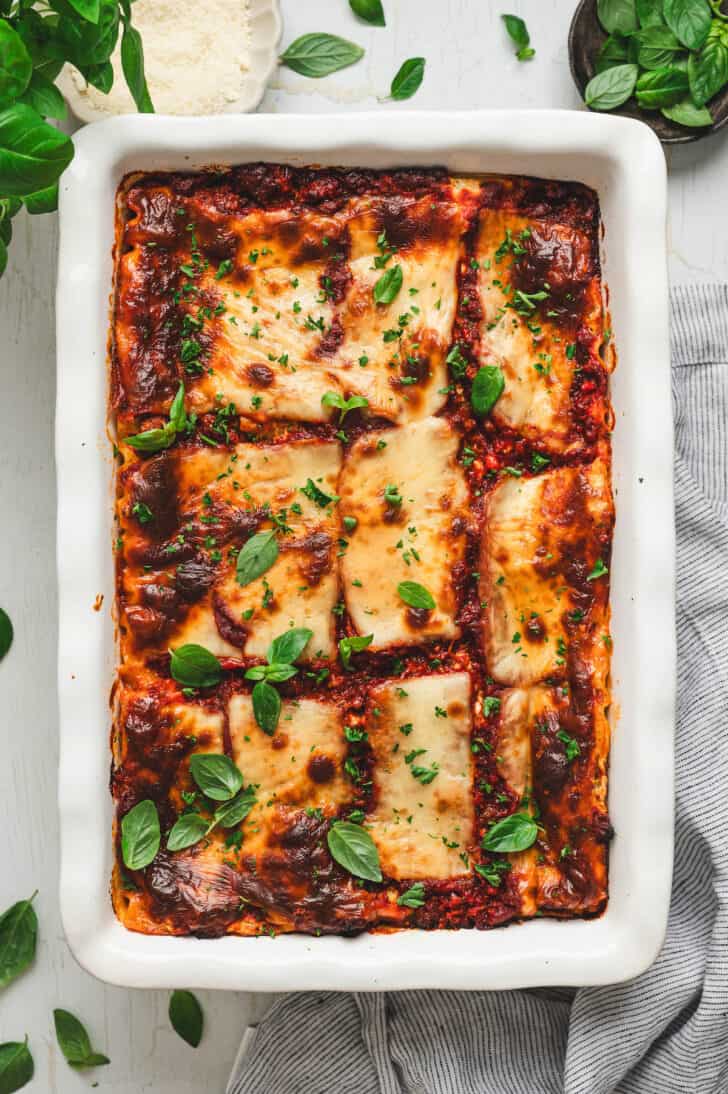
Save This Recipe!
“I made this for dinner last night and I absolutely loved it. I’m from the metro Detroit area and this is exactly how my mom made lasagna when I was growing up. I’m living in the UK now and missing home comforts and this one was perfect.”
—Kelly
“I absolutely loved this recipe! Best part is everyone in my house loves it too. I will probably use this recipe forever!!”
—April
A Lasagna Recipe With Cottage Cheese That’s Been A Midwest Classic Forever
Today, I’m sharing my family’s recipe for lasagna. My mom got the recipe from her mom (who probably got it from a newspaper or magazine), and she often made this for Christmas dinner and my birthday when I was a kid.
This recipe isn’t trendy or reinvented in any way – it’s simply the best food when you’re craving nostalgic comfort, or want to make a batch of freezer meals.
This is very clearly not an authentic Italian lasagna recipe, and that’s okay. This lasagna recipe using cottage cheese skips ricotta entirely in favor of something accessible and budget-friendly that my grandma could always find at the store.
If you grew up eating lasagna made with cottage cheese and looking to make a batch of your own, you’re in the right place.
Why You Will Love Homemade Lasagna With Cottage Cheese
- One of the very best freezer meals ever. Bake, cool, then cut into pieces and freeze for several future meals. Or, portion into smaller disposable foil pans and freeze, to bake later.
- Won’t empty your wallet. Putting together a big pan of lasagna can be a pricy proposition, but using cottage cheese and deli mozzarella slices instead of expensive ricotta and fresh mozzarella helps keep costs down.
- Customize to your liking by using a combo of beef and sausage, all one or the other, and make it spicy or mild, depending on what you like.
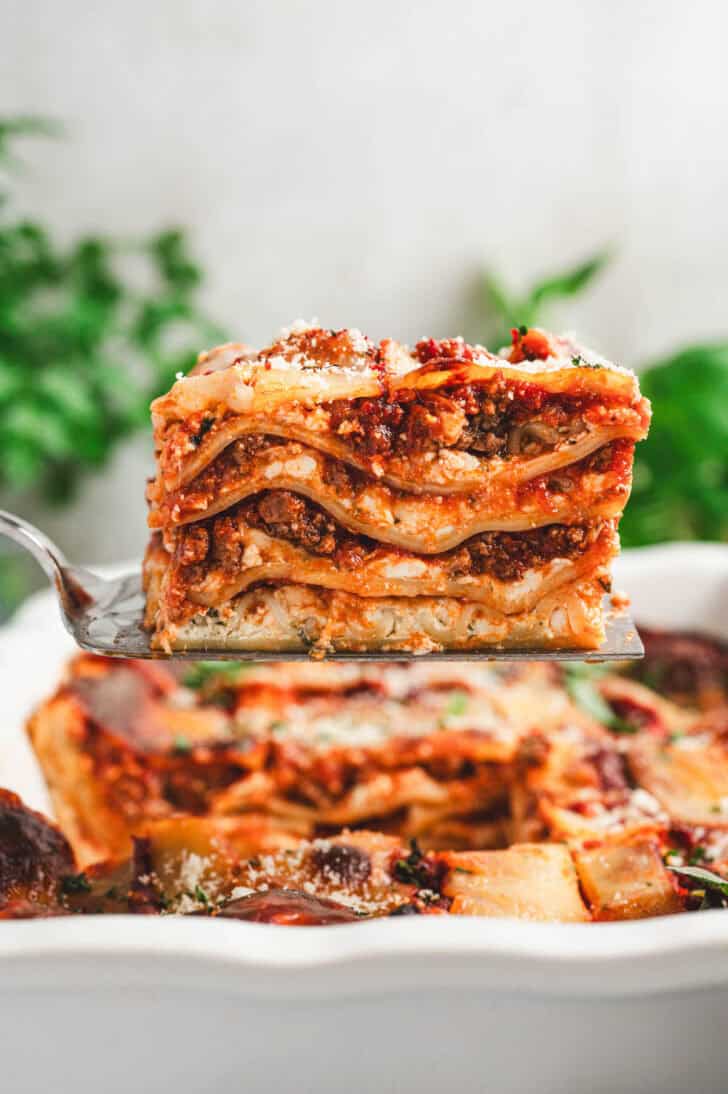
Ricotta Or Cottage Cheese For Lasagna?
This comes down to preference, and here in the Midwest, the preference is often cottage cheese. Ricotta cheese creates a smoother, richer, and let’s face it, mushier texture. Cottage cheese offers a lighter but still creamy texture and a slightly tangy flavor that works well with the rich meat sauce.
Many Midwestern cooks prefer cottage cheese because it’s affordable, accessible, and still incredibly satisfying. In my opinion, you can’t really taste or identify the cottage cheese in the finished dish unless you’re really looking for it, so even cottage cheese haters might be OK with this dish.
If you’re new to putting cottage cheese in lasagna and feeling really weird about it, feel free to use half ricotta and half cottage cheese, if you prefer. Stir them together before assembling the lasagna.
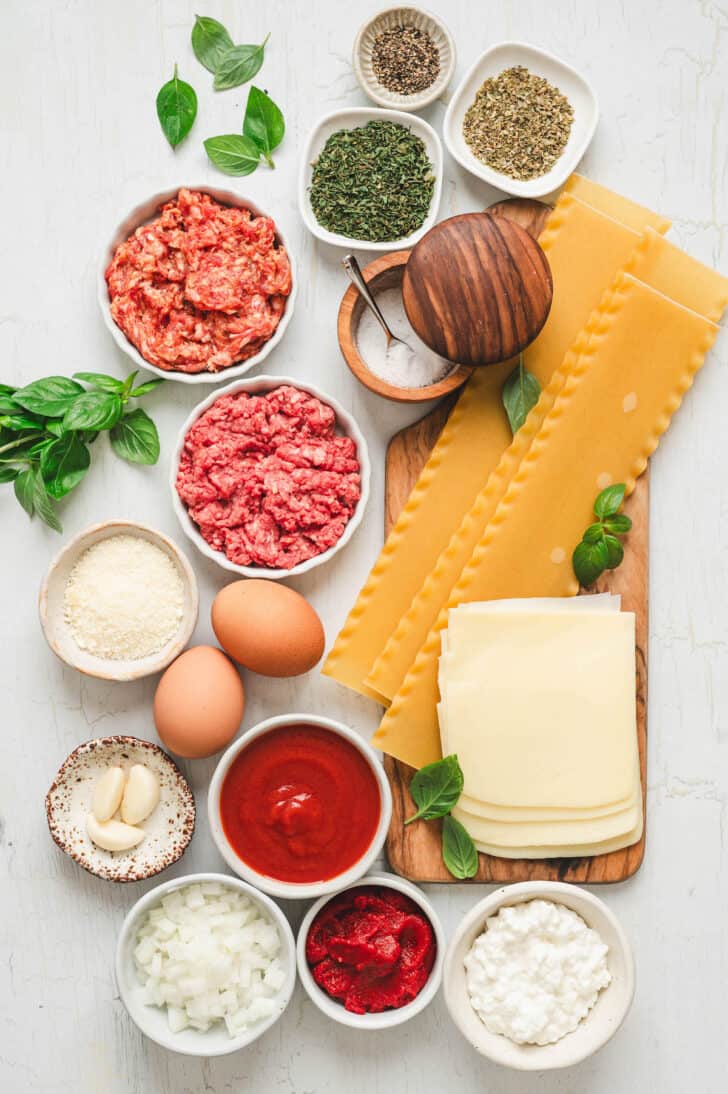
Cottage Cheese Lasagna Ingredients
A full recipe card, including exact ingredient amounts, appears at the bottom of this post.
- meat – you’ll need 1-1/2 pounds total meat for the sauce. We like a combination of ground beef and Italian sausage (you can use mild sausage or hot sausage, depending on your preference). You could also do all beef, no sausage, but we believe the sausage adds an essential depth of flavor to this dish.
- cottage cheese – the main component of the cheese sauce. Full fat, small curd is best.
- mozzarella cheese – you can use shredded mozzarella, but we’ve found that this cottage cheese lasagna recipe is easiest to assemble if you use mozzarella slices. Not the fresh, creamy mozzarella that is usually sold in a ball, but low-moisture, part-skim slices. Think cheese slices that you would put on a sandwich, so they are probably most often found at or near the deli counter.
- Parmesan cheese – adds a salty and nutty flavor to the lasagna filling with cottage cheese. You’ll want to have some extra for sprinkling on each serving, as well.
- lasagna noodles – we use traditional (you have to boil them first) lasagna noodles. We’ve never tried this recipe with no-boil noodles (because boiling the noodles can happen while you’re cooking the meat sauce, anyway, so it doesn’t take any extra time) so we can’t say how it would work.
- eggs – act as the binding agent for the cheese filling.
- onion – adds aromatic depth of flavor to the meat sauce.
- garlic – adds to the savory flavor of the sauce.
- tomato sauce – plain canned tomato sauce is the base of the sauce (we’re basically making our own marinara sauce in this recipe for lasagna with cottage cheese).
- tomato paste – thickens the sauce and adds an intense tomato flavor that is a signature of this lasagna.
- dried oregano – adds an herbal note to the sauce. You can also substitute twice the amount of fresh oregano if you have it on hand. You can also use an equal amount of dried Italian seasoning.
- dried parsley – adds an herbaceous touch to the cheese filling.
- kosher salt – needed to season the sauce, the cheese filling, and the cooking water for the pasta.
- black pepper – adds a subtle heat to the cheese filling.
- fresh basil – an optional garnish that adds pretty color.
How To Make This Lasagna Recipe Using Cottage Cheese
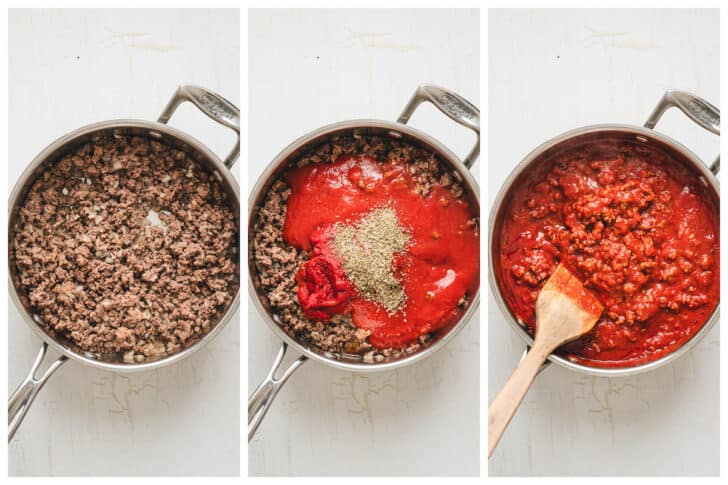
- MEAT SAUCE. In a large skillet or Dutch oven, cook the beef, sausage, garlic and onion until the meat is cooked through, breaking it up as it cooks. Stir in the tomato sauce, tomato paste, oregano and salt and simmer 30 minutes, stirring occasionally.
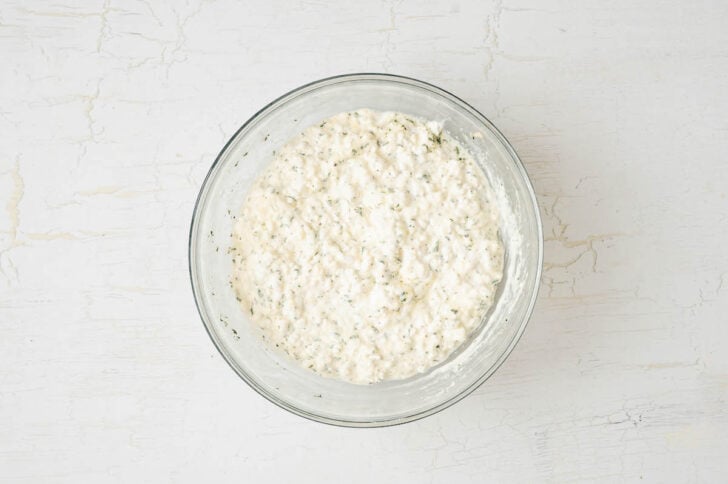
- COTTAGE CHEESE MIXTURE. While the meat simmers, stir together the eggs, cottage cheese, Parmesan cheese, parsley, salt and pepper in a medium bowl.
- COOK NOODLES. Bring a large pot of water to a boil, prepare the noodles according to the package directions, and drain.
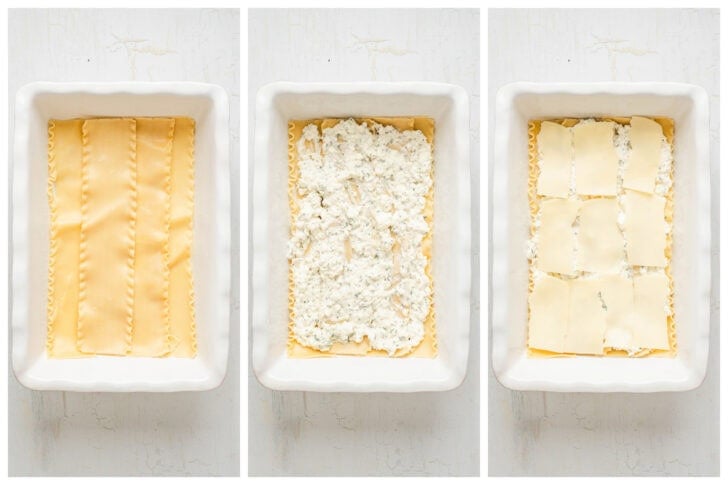
- LAYER. Spray a lasagna pan with nonstick spray. Arrange 1/4 of the noodles in the bottom of the dish. Spread the noodles with 1/4 of the cottage cheese filling. Arrange 1/4 of the mozzarella cheese slices over cottage cheese filling.
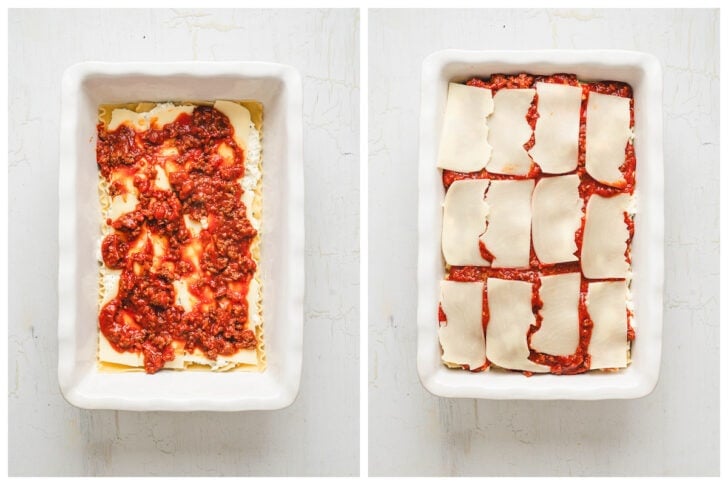
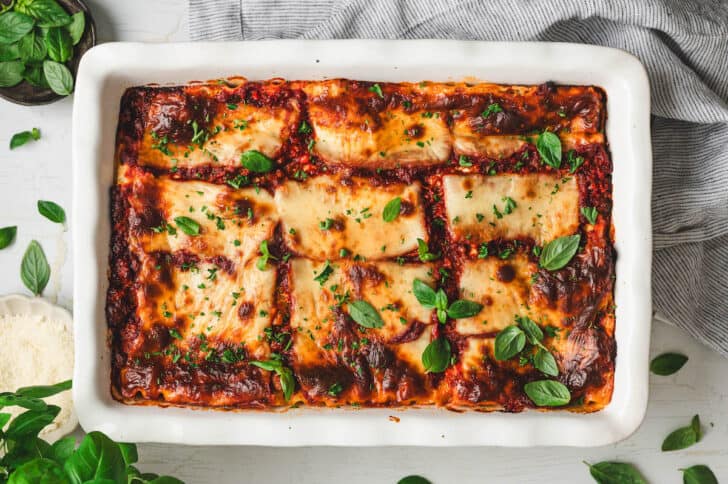
- CONTINUE LAYERS AND REPEAT. Spread 1/4 of the meat mixture over the mozzarella cheese slices. Repeat the layers 3 more times, but you can swap the order of the meat sauce and mozzarella in the final layer, if you wish to have a melty cheese layer on top of your lasagna.
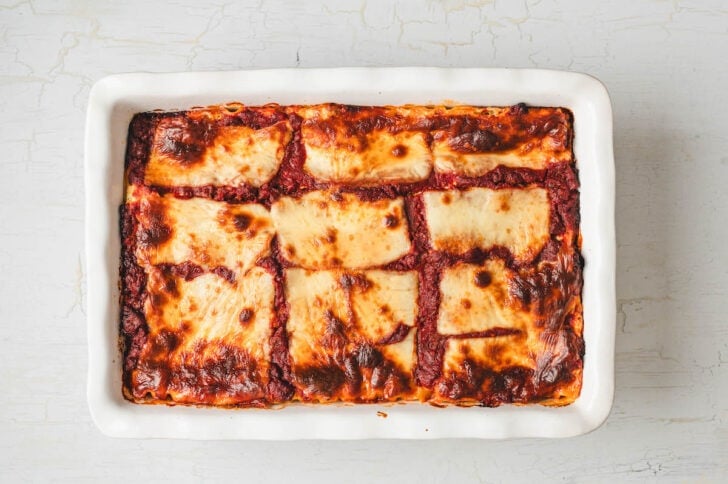
- BAKE. Bake until the edges are bubbly.
Lasagna Cottage Cheese Recipe Home Chef Tips
- It’s fine if the lasagna noodles overlap a smidge, and it’s also fine to tear them into shorter pieces to really fit them into the corners.
- When spreading the cottage cheese mixture and the meat sauce, it’s important to go all the way out to the edges and get into the corners, so that the outside pieces are just as yummy as the center pieces.
- We do NOT cover our lasagna with foil while baking. Honestly, we love when the corners and edges get some crispy bits. However, if your lasagna starts to get too brown for your liking while it is baking, feel free to loosely tent it with aluminum foil for the remainder of the cooking time.
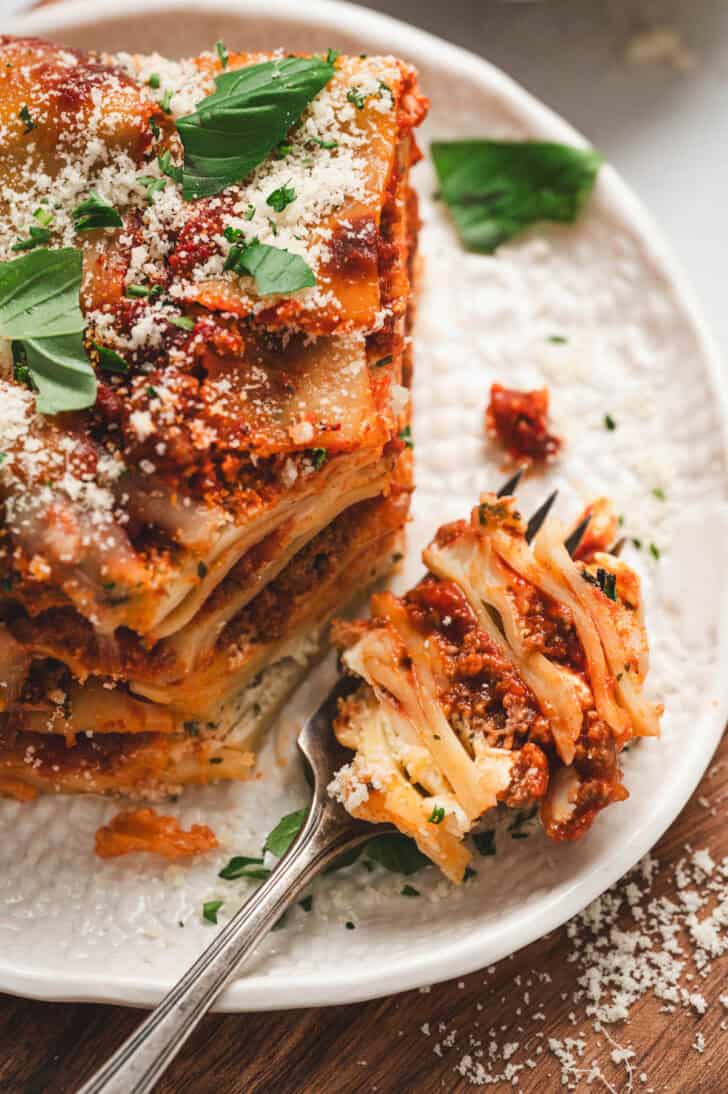
What To Serve With Cottage Cheese Lasagna
Lasagna with cottage cheese is rich, hearty and deeply savory, so it pairs best with sides that bring freshness and contrast. A crisp green salad with an acidic vinaigrette like Miso Salad Dressing or Citrus Salad Dressing helps cut through the richness.
Roasted or sauteed vegetables are another great option. Roasted Broccoli With Parmesan and Balsamic Green Beans work especially well.
And of course, no Midwesterner ever turned down some warm Homemade Garlic Bread to soak up every last bit of sauce.
Cottage Cheese Lasagna Recipe Make Ahead And Storage
- Make Ahead: This lasagna cottage cheese recipe can be assembled, covered and refrigerated, up to 3 days, or frozen up to 3 months, before baking. If frozen, thaw overnight, or even 2 days in advance if you can. Either way, bring to room temperature on the counter 1 hour before baking. If we’re planning for make-ahead meals, sometimes we’ll divide the recipe among 2 or 3 smaller disposable foil pans instead of one large dish.
- Refrigerate: If you have leftovers, transfer them to an airtight container and place them in the fridge uncovered for a few hours until they are fully chilled, then cover them with the lid and keep in the refrigerator up to 3 days.
- Reheat: In the oven or microwave until warmed through. If reheating in the oven, place leftovers in a small baking dish and add a splash of water in the bottom, so that the bottom noodle layer stays soft.
- Freeze: The easiest way to freeze leftovers in individual pieces is to bake the whole lasagna and refrigerate the leftovers in their pan overnight. It’s much easier to portion and wrap individual pieces when the lasagna is chilled than when it is warm. The next day, cut the chilled lasagna into pieces and wrap them individually in plastic wrap, then foil. Place the pieces in freezer bags and freeze for up to 3 months. Thaw in the fridge overnight before reheating.
Traditional Lasagna Recipe With Cottage Cheese FAQs
Yes! This cottage cheese lasagna recipe is designed specifically for that swap and delivers creamy, cohesive layers. We recommend using small curd cottage cheese (instead of large curd) when putting cottage cheese in lasagna, so that the curds disappear into the cheese mixture more easily and mimic the smoothness of ricotta a little more closely.
People use cottage cheese instead of ricotta in lasagna for a variety of reasons, and some of it comes down to personal preference, but availability and affordability are two major considerations. Cottage cheese is often easier to find and more affordable.
This comes down to preference, but we think it needs to have at least three layers to really get that feel of digging in to a tall piece of pasta-y, cheesy goodness. We generally do four layers in this lasagna recipe with cottage cheese, because that’s how it works out for one box of noodles to layer into a 10×16-inch pan.
There’s no wrong answer – just different textures and flavors. Some people prefer the creaminess of ricotta while others enjoy the unique texture and milder taste of cottage cheese in lasagna.
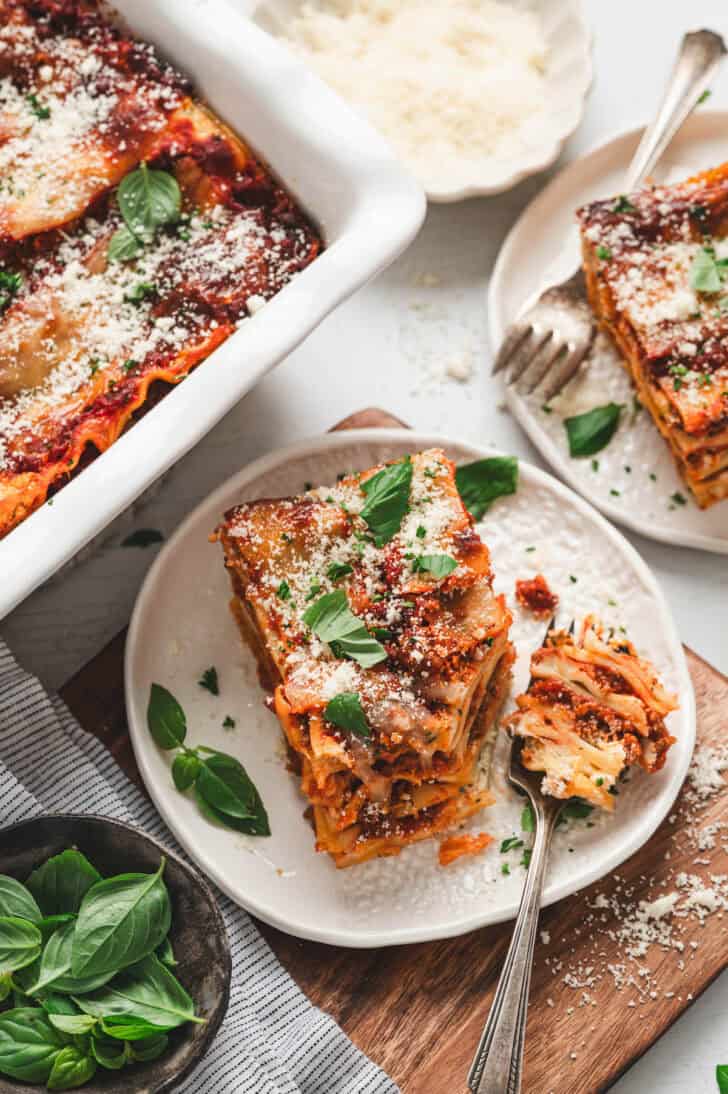
More Foxes Love Lemons Favorites
Lasagna Recipe With Cottage Cheese
Save This Recipe!
Ingredients
For the Meat Sauce:
- 1 pound ground beef
- ½ pound mild or spicy Italian sausage casings removed if necessary
- 3 garlic cloves minced
- ½ medium white onion finely chopped
- 1 can tomato sauce 29 ounces
- 1 can tomato paste 12 ounces
- 2 teaspoons dried oregano leaves
- 1 ½ teaspoons kosher salt
For the Cheese Filling:
- 2 eggs
- 3 cups small curd cottage cheese
- ½ cup grated Parmesan cheese
- 2 tablespoons dried parsley leaves
- 1 teaspoon kosher salt
- ½ teaspoon ground black pepper
For Assembly:
- 1 box lasagna noodles (traditional, NOT no-boil) 16 ounces
- Nonstick cooking spray
- 1 pound mozzarella cheese slices
For Garnish (optional):
- Additional grated Parmesan cheese
- Chopped fresh basil leaves
Instructions
- Make the Meat Sauce: In large high-sided skillet, cook beef, sausage, garlic and onion over medium-high heat 10 to 12 minutes or until meat is cooked through, breaking up meat with back of spoon and stirring occasionally. Remove and discard any excess fat in pan.
- Stir in tomato sauce, tomato paste, oregano and salt; heat to simmering over medium-high heat. Reduce heat to medium-low and cook 30 minutes, stirring occasionally. Remove from heat and let cool slightly.
- Make the Cheese Filling: Place eggs in large bowl and whisk until smooth. Add cottage cheese, Parmesan cheese, parsley, salt and pepper; stir until well combined.
- Prepare noodles according to package directions; drain.
- Preheat oven to 375 degrees F. Spray 10 x 16-inch lasagna pan or large baking dish with nonstick spray. Arrange 1/4 of noodles in bottom of dish. Spread noodles with 1/4 of Cheese Filling. Arrange 1/4 of mozzarella cheese slices over Cheese Filling (you can rip the cheese slices into halves or thirds to arrange them easier). Spread 1/4 of Meat Sauce over mozzarella cheese slices. Repeat layers 3 more times. If desired, you can swap the order of the meat sauce and mozzarella in the final layer, so you can have a layer of melty cheese on top of your lasagna.
- Transfer to oven and bake 45 to 60 minutes or until edges are bubbly. Let rest 15 minutes before serving topped with additional Parmesan cheese and basil, if desired.

Mmmm, maybe if you added a 1/2 cup water that might do it. I have never had a problem, I was comparing your liquids and mine. I use a 14 oz can puree, 14 oz. can of drained diced tomatoes, 6 oz can of tomato paste, 1/2 cup water and 1/4 cup sherry. I do use more cottage cheese, 32 oz and 3 eggs. Cooking is so fascinating!
Several years before I was married, 56 years ago, I was visiting a friend and she was making Lasagna with Cottage Cheese. She shared the recipe with me and I have been making it that way ever since. One thing that I DON’T do is boil the noodles. I do use traditional noodles. They seem to cook in the sauce just right and are always aldente. I just layer them as you would layer the boiled ones. A lot easier to handle!
So interesting, Barbara! I had no idea you could do it that way. My sauce is fairly thick when chunky, without a lot of extra liquid, so I’d be concerned the noodles would dry everything out.
I absolutely loved this recipe!!
I personally don’t favor ricotta in my lasagna, but wanted something similar to keep it as authentic as possible, best part is everyone in my house loves it too. I will probably use this recipe forever!!
I am so glad to hear that, April! Lasagna is the best 🙂
I have a couple people who won’t eat beef. Has anybody tried this with ground Italian seasoned turkey? Has anyone added mushrooms, to add a veggie component?
Hi Val – yes, this recipe can be made with turkey and mushrooms!
I COULDN’T EVEN FIND THE DAMN RECIPE! DAMN YOU BLOGGERS!
But you found the comment box? Great! The recipe is actually just a little bit above the comment box where you’ve complained. Good luck!
Omg! People!
I’ve made my lasagna eith cottage cheese since I started cooking for our family when I was 12 because my Mom arrived home exhausted every night and my two younger brothers thought they would starve to death waiting for her to prepare. something! And I grew up in Florida. I believe maybe I found the recipe in the cookbook my Mom bought me which was a Betty Crocker for kids. Making it again tonight!
This originating as a Berry Crocker recipe absolutely sounds right!
Hey, I didn’t make this lasagna, but I can see it is delicious, it resembles a recipe I have. But I am just mentioning that when I use cottage cheese for my lasagna, I use my stick blender to make it into a creamier texture. I don’t like the lumps in cottage cheese. I started doing this when I had to make my own cottage cheese because Norway (where I have lived for over 40 years) didn’t have it in the 70’s. When eventually ricotta come into the stores over here, I tried using it, but actually we all prefer the cottage cheese.
I am making your creamy salmon recipe tonight for dinner btw.
Gonna check out more of your recipes 🙂
Stick blender is a great idea for a creamier texture, Anna Marie. Personally, I don’t have a problem with the texture of cottage cheese, but this is a good option for people who would like it smoother. I hope the creamy salmon pasta was a hit!
It’s interesting that this receipe contains mozarella and parmesan cheeses but not ricotta. Are mozarella and paremesan more readily available in the Midwest .? Is this because parmesan is an aged cheese,? I known that mozarella can be stored for a while but ricotta is best when made fresh. Maybe it’s just a matter of what you”re used to or a taste preference.
Hi Carole – My grandma didn’t seem to have an issue finding mozzarella or Parmesan here in the Midwest decades ago. But as you mentioned, it could have have been simply a flavor preference as well.
Do you have the metric equivalent in milliliters (mL) for the 29 ounce sauce and the 12 ounce paste for making this in Canada using an Imperial ounce? I believe that a U.S. fluid ounce is 29.57mL and a Canadian fluid ounce is 28.41mL so if a recipe says 29oz, for example, we have to determine if the recipe was written using the U.S. or Imperial system and go bigger or smaller as required…plus that is not a size we get up here. As an aside, only liquid measurements are different. We have a smaller ounce and the actual number of those ounces in a pint, quart, and gallon is larger. Weights are the same.
Hi Ida – I do not have the metric equivalents, but the good news is that lasagna is very forgiving. Since my grandma starting making this recipe many decades ago, the can sizes here in the U.S. have definitely changed by a few ounces or even more. We just choose the package size that is closest to the recipe, and it always works out!
I made this for dinner last night and I absolutely loved it. I’m from the metro Detroit area and this is exactly how my mom made lasagna when I was growing up. I’m living in the UK now and missing home comforts and just started googling around for a recipe. This one was perfect. Thanks for a great recipe – I’m looking forward to having a look around your website for more recipes.
I’m so glad to hear you liked it, Kelly! After I published this, I was surprised to hear about how many people from the Midwest grew up eating lasagna just like this. All along, I thought my family was the weirdos putting cottage cheese in it! haha.
This is such a great recipe! My son loves lasagna and I try to make it as simple as possible so I use the no boil noodles and add spinach in the layers to add extra veggies for all of us. Soo darn good!
I’m so glad you like this recipe, Judy. And I love the idea of adding spinach!
Judy ~ I add spinach, as well! I’ve also found that I can mix in 2 eggs with the cottage cheese before layering next to the regular lasagna noodles without boiling.
This looks delicious, can’t wait to try it!
My boyfriend and I made it together yesterday. I haven’t made a lasagna in almost ten years. It was so yummy! We just added green peppers to the sauce. So glad we made it ???? Looking forward to making it again!
I’m so glad to hear that, Jess. Have a great week!
I’m unable to find good ricotta where I live so I can’t wait to try your recipe. When baking this lasagna do you cover it with foil? I seem to remember my mom covering hers for the first half of baking.
Hi Mary – no, we don’t cover ours with foil.
Mary; have you tried making your own ricotta? It is *super* simple. I use the Smitten Kitchen recipe. Give it a try!
My mom also did not enjoy cooking (which she told people all the time) but she got married in 1950 and preceded to have six children who were always hungry. And just like you, my sisters and daughters and other family members, still make many of her recipes which we all enjoy. Some of my favorites of hers are beef bbq, tuna casserole, meatloaf, and a cherry cheesecake which she got the recipe off of a Duncan Hines cake mix box. BTW – her mother, my grandma was an exceptional cook and enjoyed cooking immensely. Your lasagna recipe looks delicious. Thanks
Isn’t it funny how sometimes the best food comes from people who said they hated cooking? Thanks so much for stopping by, Peggy.
Your recipe is pretty much the recipe I learned from my mom. 🙂 Except she grew and canned her own tomatoes for the sauce. I’m making it for 40 college kids for lunch on Sunday.
Hi Susan! That’s so interesting. I feel like this lasagna may have been published in a newspaper or a popular cookbook sometime way back when. Seems like so many people (especially in the Midwest) have a similar recipe.
It was the ever famous Betty Crocker cookbook lol
I’m honored to have my lasagna recipe featured on FLL!! The photos are amazing. Thanks, Lor❤️ Glad you always enjoyed it as you were growing up.
Thanks for sharing your recipe! <3