

How To Cook Prime Rib In The Oven
 by
Learn how to cook Prime Rib in the oven with a beautiful browned crust and juicy center. Includes oven temperatures, cooking times and tips for perfect doneness.

Save This Recipe!
How To Cook Prime Rib In The Oven For A Perfect Holiday Roast
A beautiful bone-in prime rib roast is the centerpiece of many holiday meals. But because it’s one of the more expensive cuts of beef you’ll cook at home, getting it right can feel a little intimidating.
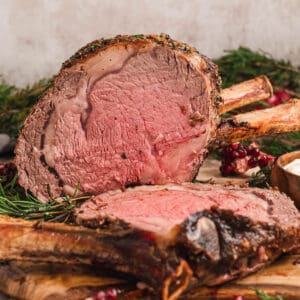
I’ve made perfect prime rib for a special occasion many times, and I keep coming back to this straightforward oven method. Instead of relying on a certain number of minutes per pound, I start the roast at 450°F to develop a browned crust, then reduce the temperature to 300°F and cook until the center reaches my desired doneness.
For medium rare, I remove the roast from the oven at 125°F, then let it rest for 20 to 30 minutes before carving. This method gives me the flavorful exterior and juicy center I’m looking for, without having to constantly watch the oven.
Heads up! You might need these other recipes to cook and serve the best prime rib of your life:
Why You’ll Love Prime Rib In Oven
- It’s surprisingly hands-off. Once the roast goes into the oven, you only need to lower the temperature once and monitor the internal temperature. That leaves plenty of time to prepare your side dishes and chat with your guests.
- You get a beautifully browned crust and juicy center. Starting at 450°F develops the exterior, while finishing at 300°F allows the center to cook more gently.
- There’s no guessing about doneness. A meat thermometer tells you when the roast is ready, so you don’t have to rely on cooking times alone.
What Is Prime Rib?
Also known as standing rib roast, prime rib is a cut of beef from the primal rib section of the cow. It’s prized for rich marbling (and thus, flavor) and tenderness. Typically, prime rib is roasted with the bone in to achieve the richest flavor.
Despite its name, prime rib doesn’t necessarily mean the beef is USDA Prime grade. You’ll also find rib roasts graded USDA Choice at the grocery store, which can be a good option for a special dinner.
How Much Prime Rib Per Person?
When planning a feast, aim for about 1 pound of bone-in prime rib per person for a satisfying portion. It sounds like a lot, but it takes into account the weight of the bone, as well as the fatty marbling that often goes uneaten (but enhances the flavor of the meat).

Prime Rib Ingredients
A full recipe card, including exact ingredient amounts, appears at the bottom of this post.
- bone-in rib roast – I like a 6- to 7-pound roast (3 bones) to feed 6 people comfortably and maybe have a bit of leftovers. Have your butcher help you pick one with good marbling!
- rub – see my post about Prime Rib Roast Rub Recipe for a rub that is a combination of kosher salt, fresh herbs, spices, garlic cloves and shallots. It forms an irresistible crust on the outside of the roast.
- oil – I use canola or vegetable oil because both have a neutral flavor and work well with the high initial oven temperature.
How To Cook Prime Rib

- ROOM TEMP. Take the roast out of the refrigerator before cooking. I allow up to 2 hours for this step, but don’t leave raw beef at room temperature any longer than that.
- RUB. Preheat the oven. Pat the roast very dry with paper towels, then drizzle the roast with oil and rub it on all sides. Then, slather the roast all over with the rub.

- ROAST. Place the roast bone side down in a shallow roasting pan, rimmed baking sheet or shallow baking dish. Roast at 450°F for 20 to 30 minutes, until the outside is nicely browned. Reduce the oven temperature to 300°F and continue roasting until the center reaches your desired temperature (more on this below).
- REST. After cooking, allow the meat to rest for 20 to 30 minutes before carving and serving with Creamy Horseradish Sauce. You can tent the cooked roast loosely with foil while it rests, to keep it warm for serving if you need to extend the rest time beyond that.

How Long To Cook Prime Rib
For a 6- to 7-pound bone-in prime rib roast, I start with 20 to 30 minutes at 450°F, then reduce the oven temperature to 300°F and continue roasting until the center reaches my desired temperature.
For medium rare, I remove the roast at 125°F. The lower-temperature portion of cooking may take around an hour or longer, but the total time varies depending on the size and shape of your roast, its starting temperature and your oven.
Use cooking time as a planning guide, not your final doneness test. If you don’t have a leave-in probe thermometer, begin checking the internal temperature after about 60 minutes of total oven time.
Prime Rib Temperature Chart
Prime rib continues cooking after you remove it from the oven, a process called carryover cooking. The internal temperature may rise several degrees or more while the roast rests, depending on its size and how hot it is when you remove it. Use the chart below as a guide, and keep in mind that the final temperature may vary.
| Desired Doneness | Pull From Heat At | Approximate Final Temperature |
| Rare | 115 degrees F | 120 to 129 degrees F |
| Medium Rare | 125 degrees F | 130 to 134 degrees F |
| Medium | 130 degrees F | 135 to 144 degrees F |
| Medium Well | 140 degrees F | 145 to 154 degrees F |
| Well Done | 150 degrees F | 155 to 164 degrees F |
Food Safety Note: The USDA recommends cooking beef roasts to a minimum internal temperature of 145°F, followed by at least a 3-minute rest. Lower temperatures listed above reflect traditional prime rib serving preferences.
Prime Rib Roast Recipe Home Chef Tips
- Work the rub all over the roast. Don’t just sprinkle it on top. Use your hands to press the rub into every exposed surface of the beef so you get plenty of seasoning in each bite.
- Leave your roast uncovered while cooking so that the outside gets nice and brown.
- It’s critical that you use a good quality thermometer to achieve the proper cook on the roast in this prime rib recipe. An instant read probe thermometer comes in handy in the kitchen quite often, but there’s nothing like a probe meat thermometer with an external display for cooking a roast.
- Keep the thermometer away from the bones. Insert the probe into the thickest part of the roast, without touching bone, for the most accurate reading.
- Give the roast time to rest. Allowing 20 to 30 minutes before carving helps the juices redistribute and gives you time to finish the rest of dinner.
Best Sides For Prime Rib
When I’m making prime rib for a holiday dinner, I usually serve one potato dish, one or two vegetables, and some bread or rolls. I like sides that feel special enough for the occasion but don’t require too much attention while the roast is in the oven. Here are some of my favorites.
Potatoes
Vegetables

Prime Rib Make-Ahead, Storage And Reheating
- Make-Ahead: I recommend cooking prime rib shortly before serving for the best texture and flavor. You can prepare the Prime Rib Rub ahead of time to save some prep work.
- Storage: Transfer leftover prime rib to an airtight container and refrigerate within 2 hours of cooking. Store in the refrigerator for up to 3 days.
- Freezing: Wrap leftover prime rib tightly in plastic wrap, then place in a freezer bag or airtight container. Freeze for up to 3 months. Thaw overnight in the refrigerator before reheating.
- Reheating: To keep the meat from drying out, reheat it gently using the hot water bath method outlined in my Leftover Prime Rib Sandwich recipe.
Prime Rib In Oven FAQs
It’s best to cook prime rib uncovered to allow a crust to develop. Covering the roast would trap steam and make the exterior less crisp, so for a nice brown crust, keep it uncovered in the oven.
Starting with a high heat sear, then lowering the temperature, allows prime rib to cook evenly, preventing overdone edges and giving a juicy medium-rare center. So it’s best to cook it fast up front, then slow the cook down after the sear.
Prime rib and rib roast generally refer to the same cut of beef. A standing rib roast is typically bone-in, while a rib roast can be sold either bone-in or boneless. The term “prime rib” doesn’t necessarily mean the beef is USDA Prime grade.
Why reverse searing (searing the prime rib after roasting it) has its fans, I prefer the traditional method of searing the roast first and then continuing to cook it in the oven until it is done. This classic, simple technique is straightforward, easy, and always works well.
The 500-degree method involves roasting prime rib at 500°F for a calculated amount of time, then turning the oven off and leaving the roast inside with the door closed to finish cooking. This method depends on how well your oven retains heat. I prefer starting at 450°F, lowering the temperature to 300°F and monitoring doneness with a meat thermometer.
The most reliable way is with a meat thermometer inserted into the thickest part of the roast, away from the bones. For my preferred medium-rare result, I remove the beef at 125°F and let it rest for 20 to 30 minutes, during which the internal temperature continues to rise.

More Foxes Love Lemons Favorites
How To Cook Prime Rib In Oven
Save This Recipe!
Ingredients
- 6 – 7 pounds bone-in rib roast
- 2 tablespoons canola or vegetable oil
- 1 batch Prime Rib Rub
Instructions
- Take the roast out of the refrigerator before cooking. Allow up to 2 hours for this step, but don't leave raw beef at room temperature any longer than that.
- Preheat oven to 450 degrees F. Place roast bone side down in a shallow roasting pan, rimmed baking sheet, or shallow baking dish. Pat roast very dry with paper towels. Rub roast on all sides with oil, then rub herb mixture all over each side of the meat.
- Transfer to oven and cook 20 to 30 minutes or until a deep sear develops on outside of meat. Reduce oven temperature to 300 degrees F and continue cooking until center of roast reaches 125 degrees F for medium rare. If you don't have a meat thermometer with an external display, begin checking internal temperature after 60 minutes total.
- After cooking, allow meat to rest for 20 to 30 minutes before carving. You can tent the cooked roast loosely with foil while it rests, to keep it warm for serving if you need to extend the rest time beyond that.

I know you’re gonna come to my rescue with this standing rib roast recipe on Christmas, Lori, because I’ve loved every single recipe of yours that I’ve tried. I literally only prepare a standing rib roast once a year, at Christmas, so I always have to dust off my recipe for a refresher course. However…I’m out of state and don’t have my recipe handy, but your rub sounds so fantastic that I’m pretty sure I’m gonna throw rocks at mine when I get home and always use yours from now on. I picked up a few tips on your prep method, too. News at 11, as they used to say. I’ll get back on here in a few weeks and give you and your followers the outcome. Wish I could roast it today!
I am so glad my recipes have been a hit for you, Cindy! I can’t wait to hear how this prime rib turns out. Have the best Christmas!